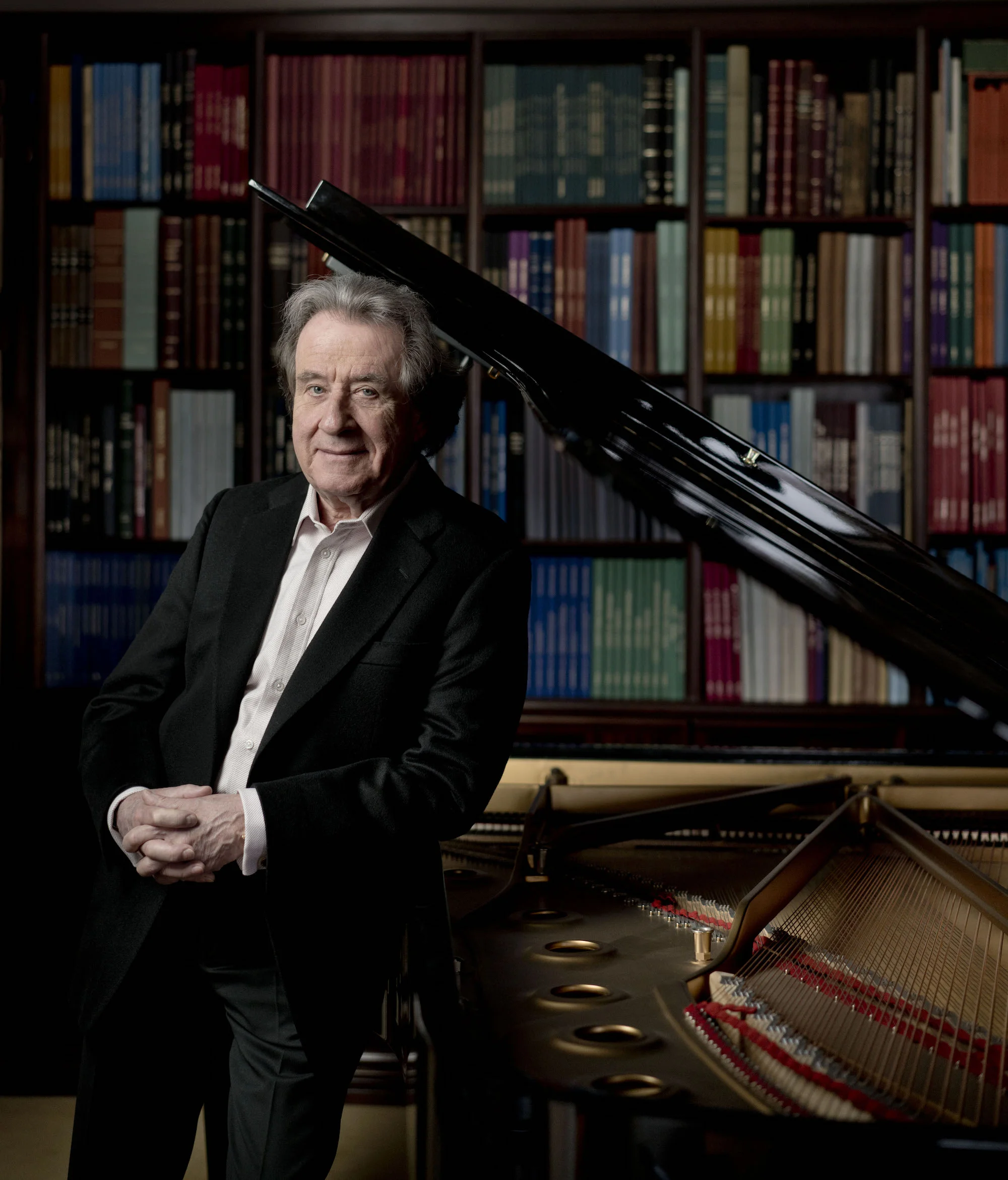
BIOGRAPHY
A LIFE IN MUSIC - With a career spanning seven decades, Rudolf Buchbinder is universally recognized as one of the most distinguished figures in classical music. His artistry is defined by a rare and vital synthesis: the profound, scholarly authority of the Austro-German tradition met with an irrepressible, youthful spontaneity.
As Rudolf Buchbinder marks his 80th birthday in 2026, his global presence reaches a new crescendo. A centerpiece of this anniversary year is his collaboration with the Vienna Philharmonic, comprising a dedicated series of six concerts. This celebration extends into an extensive international tour—notably crossing to the United States for a series of performances of the five Beethoven concertos with the Los Angeles Philharmonic under the baton of Gustavo Dudamel. Buchbinder will also embark on a major tour of Asia alongside Christian Thielemann and the Staatskapelle Berlin. These performances, complemented by his extensive appearances across Europe, underscore his status as a legendary figure at the absolute pinnacle of his artistry.
Beyond the stage, Buchbinder is a transformative force in the European cultural landscape. As the long-standing Artistic Director of the Grafenegg Festival—a position he has held since the festival’s inception in 2007—he has guided the institution to become a vital pillar of international orchestral culture. The 2026 inauguration of the Rudolf Buchbinder Saal within the festival's redesigned Reitschule stands as a permanent tribute to his curatorial legacy, creating a premier space where the world’s leading soloists and orchestras converge.
Buchbinder’s relationship with the music of Ludwig van Beethoven is the global benchmark. Having performed the complete cycle of 32 piano sonatas more than 60 times across the world’s major stages, his interpretations possess a depth of experience that is unmatched. His approach is rooted in an unparalleled commitment to source material; he maintains a private archive of 39 different historic editions of the Beethoven sonatas, including rare first-printings and autograph copies. This scholarly rigor ensures that every performance is as intellectually grounded as it is emotionally transcendent.
While synonymous with Beethoven, the artist's musical curiosity remains a driving force. With the edition BUCHBINDER:BEETHOVEN, Deutsche Grammophon presented a complete recording of the 32 piano sonatas and the five piano concertos in 2021, thus creating a sounding monument to two outstanding Buchbinder-Beethoven cycles of recent times. Buchbinder was the first pianist to play all of Ludwig van Beethoven's piano sonatas within one festival summer at the 2014 Salzburg Festival. The Salzburg cycle was recorded live for DVD (Unitel) and is also available on nine CDs.
The cycle of Ludwig van Beethoven's five piano concertos came about during the celebration of the Vienna Musikverein’s 150th anniversary. For the first time in its history, it gave a single pianist, Rudolf Buchbinder, the honor of performing all five piano concertos by Ludwig van Beethoven in a specially curated series. Buchbinder's partners in this unprecedented constellation were the Leipzig Gewandhaus Orchestra under Gewandhauskapellmeister Andris Nelsons, the Vienna Philharmonic under Riccardo Muti, and the Bavarian Radio Symphony Orchestra, the Munich Philharmonic and the Sächsische Staatskapelle Dresden under their then principal conductors Mariss Jansons, Valery Gergiev and Christian Thielemann. All concerts were recorded live.
Buchbinder's recent recording project, Schubert Treasures, features a definitive exploration of over 175 "musical microcosms", uncovering new revelations within the intimate dance repertoire of the composer. Whether tackling the complex variations of Diabelli or the refined elegance of the Viennese classics, Buchbinder approaches every score with what he describes as the "luxury of intelligent naivety"—a rare ability to maintain freshness of perspective while drawing upon a lifetime of profound insight.
His commitment to the instrument transcends his own performances. As the curator of the prestigious Prix Serdang, he actively mentors and champions the next generation of pianists, scouting exceptional talent based on their artistic maturity and creative potential. This dedication to legacy is mirrored in his prolific writing; his books, including his autobiography Da Capo, My Beethoven – Life with the Master, and his most recent publication, The Last Waltz, serve as essential texts for students and professionals alike. Through his scholarship and mentorship, Buchbinder ensures that the principles of deep inquiry and artistic integrity remain at the heart of the next generation’s development.
An honorary member of the Vienna Philharmonic, the Israel Philharmonic, the Vienna Symphony, and the Gesellschaft der Musikfreunde in Wien, Buchbinder is a central pillar of the classical establishment. He is the first soloist to be awarded the Golden Badge of Honor by the Staatskapelle Dresden, a testament to his unique standing among the world’s elite ensembles.
PORTRAIT
„The greatest natural pianistic talent" - a portrait by Joachim Kaiser
When Rudolf Buchbinder, as he jovially recounts, once met Friedrich Gulda at the Munich hotel “Vier Jahreszeiten”, a very characteristic conversation took place between the two artists, who both greatly appreciated each other as pianists. When Gulda asked him where he was going, Buchbinder answered truthfully: “to the concert for my Beethoven cycle.” to which Gulda replied: “Say, aren’t you bored of Beethoven yet?” Buchbinder responded as follows: “To be honest, the question is completely incomprehensible to me, because I always discover something new in such masterpieces ...” Overly sceptical readers may consider that mere lip service, although Buchbinder also repeatedly expresses this sentiment in his memoirs. “You may overindulge and get bored of some foods. But you can never overindulge when it comes to playing the masterpieces of piano literature, even if you have performed them hundreds of times”, one passage reads. Buchbinder's confession sounds touchingly idealistic: “I aspire to experience the pinnacle of my pianistic career at the end of my life. Of course, I do not know when that will be ... which is a shame, in a way! Because in my profession you have never actually accomplished something - there is always more to be achieved.“
Anyone who has been closely acquainted with Buchbinder for a long time knows full well that all these statements are pure sincerity! For years I helped my friend “Rudi” moderate his Beethoven cycles at the Schleswig-Holstein-Festival, in Dortmund/Bochum, in Nuremberg ... That means I analysed every sonata, begging him for manifold quotes. And then, finally, he presented the work in context. This way I really experienced up-close how the sonatas continuously evolved, enriched, transformed in Buchbinder's soul. Not so much with regard to the pianistic, manual aspects, which were however certainly not neglected. But in terms of depth and content. Sometimes I failed to realise the extent of what I expected of him. Once, it was about the “Hammerklavier Sonata” Op. 106, I talked for almost 50 minutes. But he was not allowed to just sit there quietly and daydream, he had to pay close attention because he was always being asked for quotes, and then finally, after this exhausting discourse, he would present the most difficult sonata of the piano literature.
The question as to why great music can captivate an artist for life, even if all he strives for is “simply” to bring the compositions to life faithfully, without violating them - this question can be answered as follows: Meaningful classical music contains a wealth of nuanced spiritual shapes, expressions, experiences and insights, of which non-musical contemporaries have no inkling. Such music is like an infinite reservoir of emotional experience! It teaches us to perceive even what is exceptionally delicate, intricate, differentiated. Mendelssohn was certainly right when he once declared that it is not true that music is meaningless and vague and that national language is clear and concrete. Because tones have infinitely more intermediate stages of shaped feelings than there are words to name all these nuances. And that's what a great pianist takes on.
In coping with the challenges posed by the works of traditional art and the “classical modernism”, Rudolf Buchbinder is helped by some remarkable artistic and human peculiarities. First of all: To me, he is the greatest natural pianistic talent I ever have encountered in my life. He never has to write down fingerings, and he doesn’t do it even when faced with the most intricate difficulties! The fingers find their way by themselves. Enviably, he can firmly rely on that. He states: “There are three types of fingerings: the one you study, the one you recommend to colleagues, and the one you find yourself doing at the concert.” The concept of “finding yourself doing something” reveals how amazingly innate Buchbinder's natural talent works. Such talent could lead to carelessness. But for that the compositions are too sacred to him, too dear. Which leads to the second special peculiarity: Buchbinder studies urtext editions respectfully and meticulously, he seeks and finds errors and does not take anything for granted. His perhaps most important, but by no means most spectacular third peculiarity: He is completely free from any affectations. It is impossible to identify any “airs” with him. Any helpful tick or trick that pushes the artist’s personality in front of the work. His interpretations when he masters Mozart concertos with a cantabile, intimate tone, when he seems to provide the piano's poignantly painful answers in the dramatic dialogue in the Andante of Beethoven's G major Concerto a hesitant hundredth of a second too late, which seems to conceal so much trepidation, fear, pain - all this comes straight from the heart of the matter. His elementary, musical freedom from all affectations makes him sensitive to the subtle or crude exaggerations of some of his colleagues. For instance, ever since Sviatoslav Richter once performed Schubert's great B-flat major Sonata ludicrously expressively slow, it has now become almost fashionable to force Schubert's sorrowful andante phrases as adagios or even largos in order to illustrate their mournfulness. But the pianistic high priests of adagios do not realize how much they miss Schubert's idiosyncratic truth. Because with Schubert there is a disheartened andante ambling, which must not be turned into a grave adagio funeral march, and certainly not a melodramatic largo - and the ethereal despair of which is incredibly difficult to get right. It is with such an aura of depressive ambling that the first song of the “Winterreise”, the second movement of the Great C major Symphony (“andante con moto”), should begin, and in which the middle movements of the Great A major Sonata (DV 959) and particularly the mysterious B flat major Sonata (DV 960) must commence. Only the slow movement of the C minor Sonata (DV 958), where Schubert evidently consciously alludes to Beethoven, is actually of the same kind as the A flat major adagios that young Beethoven liked to compose.
In listing Buchbinder's remarkable qualities there is one I have forgotten, which is perhaps the rarest - his complete lack of vanity. This is not something he has to “force upon himself”, it is not false modesty for the sake of being liked. He simply cannot help it. He detests pompous self-importance, grandiose posturing. He responds objectively and friendly. He would certainly also like to argue about whether it is really appropriate to juxtapose contemporary light music, pop music and traditional serious music as similar forms of entertainment. Of course there may be enchanting light music and mind-numbing symphonies. But the respective qualities or weaknesses have nothing to do with each other. Great traditional music absorbs the incomparable history of the language of serious music, which has been differentiated over centuries. Bach's Mass in B minor contains a huge history of church music. Beethoven's Sonata Op. 110 reaches back through the centuries with its recitative and “Johannes Passion” arioso, as do Wagner's “Meistersinger” and his “Parsifal”. Even the most successful manifestations of powerful film music or pop song production have completely different qualities. Do they not? I would also like to talk about Buchbinder's opinion that anyone who plays Bach on a Steinway should in no way try to play historically on a modern piano.
Final question: What is actually behind Buchbinder's great reluctance to listen to his own recordings after they have detached themselves from him? Is this an almost superhuman lack of vanity? Or might he even fear that he will rob himself of his free-flowing art if he meets it in the acoustic mirror?
Joachim Kaiser (2004)


